

You think you saved money buying a R5,000 template, but what is the actual website cost South Africa businesses end up paying in the long run? A template website from a local freelancer feels like a win until you run Meta Ads to it.
Let me show you why that is the most expensive mistake you will make this year.
When you purchase a generic, drag-and-drop website template, it arrives pre-packaged with thousands of lines of bloated, redundant code. The platform has to accommodate every possible layout option, meaning your site forces the user’s browser to load code it does not even use.
On a desktop in Sandton, it might look fine. But your customers are not there.
Over 77% of online shoppers in South Africa conduct transactions using their mobile devices. At the same time, despite recent regulatory shifts, South African mobile data costs remain highly expensive relative to average household incomes, with prepaid 1GB data still averaging around R79.
When a prospect clicks your Instagram or Facebook ad, their mobile device has to download every single line of that bloated code over a metered, expensive connection. The result? Latency. If your website takes longer than 3 seconds to load, over 53% of those mobile visitors will abandon the page entirely. You paid for the ad click, but the visitor left before they even saw your logo. That is the template tax.
The Bottom-Line Equation: Website Cost South Africa vs. Cost-Per-Lead
Let us look at the actual mathematics. If you spend R10,000 a month on Meta Ads with an average cost-per-click (CPC) of R5, you receive 2,000 visitors. If your site speed causes a 60% bounce rate due to mobile latency, 1,200 visitors disappear into thin air before your site even renders on their screens.
Using the standard conversion cost formula, we can calculate your true, adjusted cost-per-click:

Plugging in your numbers:

Your real cost-per-click is no longer R5; it has effectively more than doubled to R12.50. You are burning your hard-earned marketing resources to fund a slow website.

To solve this, custom web design prioritizes clean code, minified CSS and JavaScript, and modern WebP image compression to drive your Largest Contentful Paint (LCP) speed down to under 2 seconds.
The Inspired Speed Playbook: Going Custom for Absolute Performance
If you want to achieve perfect Google PageSpeed scores and convert expensive traffic, you must execute three non-negotiable steps:
Strip Out Bloated Builders and Go Native
Ditch the heavy visual builders that inject nested container bloat and load massive JavaScript libraries on every single page visit. Building your site natively with WordPress Gutenberg blocks ensures that the code served to your visitors is clean, lightweight, and semantic. The heavy editor scripting stays in your dashboard—it never gets shipped to the user.
Crop, Resize, and Compress Images Before Upload
Never upload raw, high-resolution PNGs or JPGs directly to your media library.
- Identify the exact size your image will render on mobile screens.
- Crop and resize the image in tools like Photoshop or Squoosh to those precise dimensions before uploading.
- Export the file directly as a lightweight WebP format to reduce file sizes by over 30%.
Defer Non-Critical JavaScript Manually
Third-party tools like tracking pixels, analytics, and chat widgets can easily drag down your page load speed. Do not install heavy optimization plugins to fix this. Instead, when pasting your tracking codes into your theme’s header files, manually add the defer or async HTML attributes:

This tells the browser to download the script in the background while prioritizing the immediate rendering of your page’s visual elements, eliminating render-blocking delays.
Case Study: From R1,840 to R412 per Lead
o demonstrate the real-world impact of custom technical optimization versus low-cost, template-based construction, let us look at a Cape Town-based professional services firm. The firm decided to replace its R6,500 template site with a professionally designed R32,000 custom WordPress website configured specifically for SEO and local lead generation.
These are the recorded metrics at Month 6 compared to their old baseline:
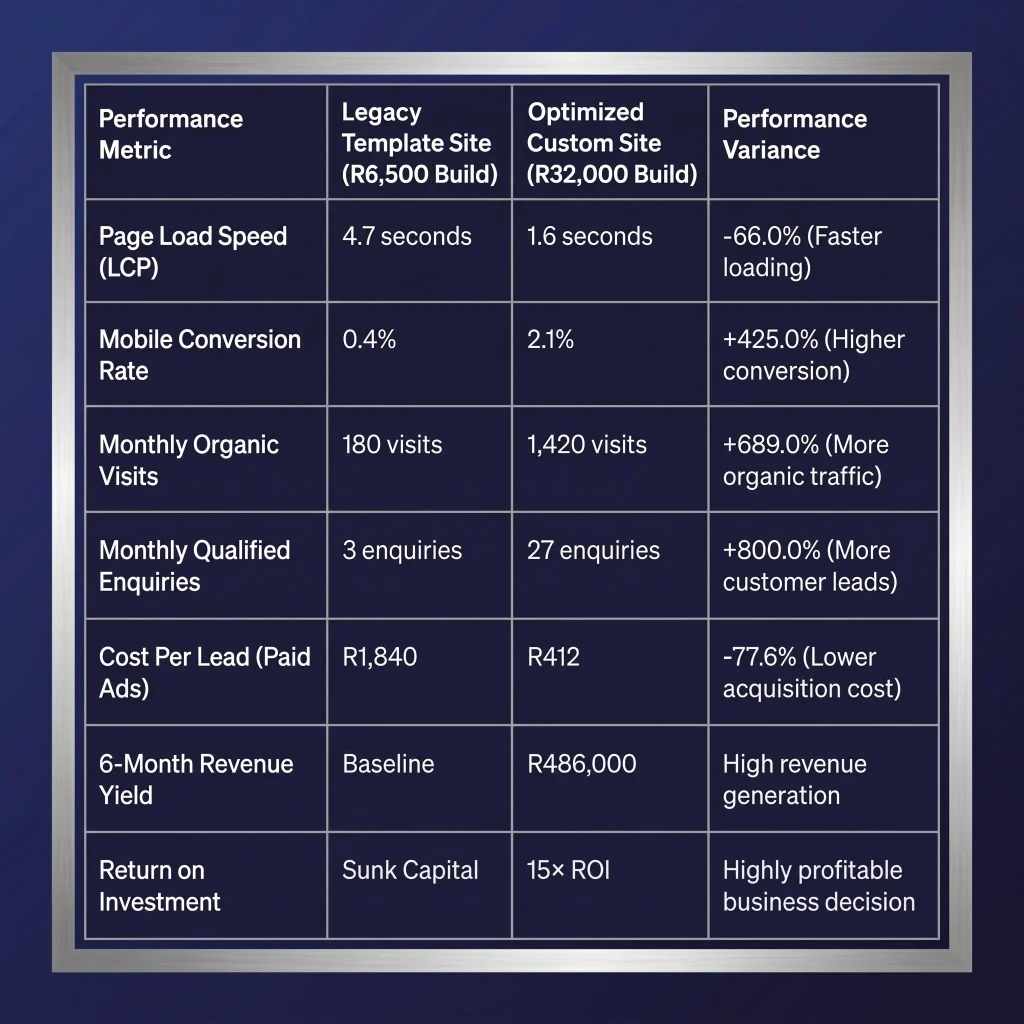
This empirical data confirms that a cheap template website is often the most expensive option in practice. By failing to convert mobile visitors and requiring highly inflated advertising spend per lead, unoptimized templates bleed capital silently. Investing in highly optimized, custom digital infrastructure is a business decision that yields dramatic, compounding financial returns.
The Bottom-Line Equation: Website Cost vs. Cost-Per-Lead
Stop evaluating your website by its upfront build cost. Evaluate it by its cost-per-lead.
If a R6,500 site requires you to spend R1,840 to acquire a single lead, it is a liability. If a R32,000 custom site acquires that same lead for R412, it is a highly profitable asset that pays for itself in a matter of weeks.
At Inspired Social, we don’t treat marketing as an aesthetic playground. We treat your digital infrastructure as a strict financial equation. We custom-code lightning-fast, block-based environments engineered specifically to strip away platform bloat, capture high-intent traffic, and maximize your ROI.
Ready to stop bleeding ad capital? Let us audit your site’s performance and build custom, high-speed digital infrastructure designed to convert.