
When looking to scale online, comparing the strategic benefits of social media vs website for business is one of the most critical decisions you will make. In the South African commercial landscape, only 28% of local businesses currently have their own dedicated website.
They believe that because they have an active Instagram page, a Facebook community, or a WhatsApp Business catalog, they have successfully digitized their operations.
This is the commercial equivalent of building a luxury office building on rented land. You do not own the land, you do not control the lease, and the landlord can change the locks or double the rent overnight without your consent.
If your digital strategy in South Africa depends solely on third-party networks, you are sitting on a severe structural vulnerability. Let us look at the raw math, the algorithm physics, and the security threats that prove relying on social media is a dangerous path for your brand.
The Stranglehold: How Social Media Algorithms Artificially Suppress Your Voice
Facebook Organic Reach Benchmarks in 2026
The golden age of “free organic marketing” on social media is completely over. It did not die by accident; it was systematically phased out by platform monetization models designed to maximize ad revenue by forcing brands into paid dependency.
Let us evaluate the numbers:
- In 2012, organic reach on Facebook sat at a healthy 16%.
- By 2018, it dropped to 2% to 6%.
- Today, organic reach on Facebook business pages averages less than 2%.
- Instagram organic reach hovers at a negligible 1% to 3% for larger accounts.
This means if you have spent years building a database of 10,000 followers who explicitly clicked “Follow” to see your updates, the platform’s algorithm hides your content from 98% of them.
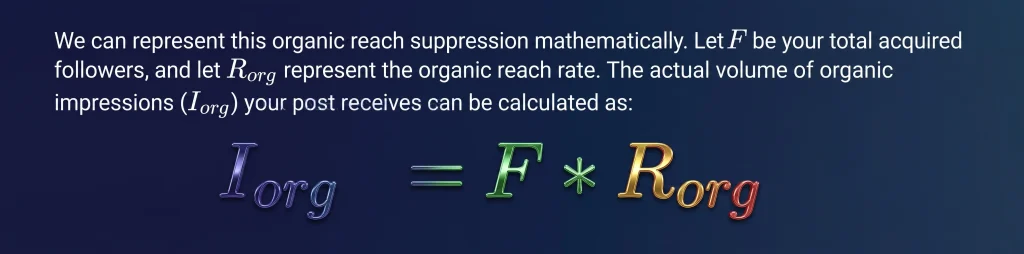
If your South African business has 10,000 followers and the organic reach rate sits at the standard 1.52% benchmark (0.0152):
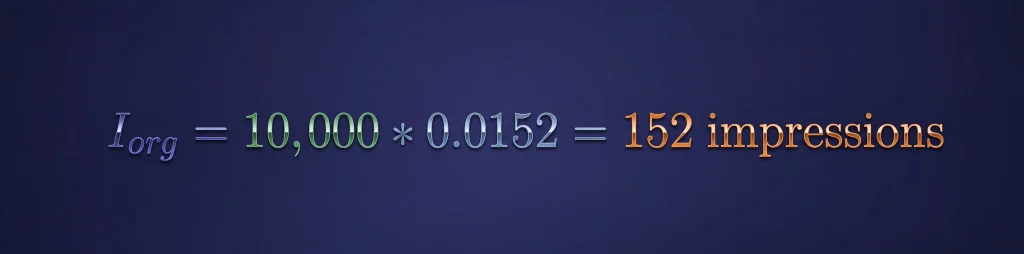
Out of your 10,000 hard-earned followers, only 152 people see your post. To reach the other 9,848 people who already follow you, the platforms demand that you pay an “attention tax” through sponsored ad campaigns.
This algorithmic manipulation has driven Meta’s advertising revenues from $1.97 billion in 2012 to over $117 billion. They created artificial scarcity by throttling your reach, and as CPMs (cost per thousand impressions) have surged over 300%, businesses relying solely on organic postings have been rendered practically invisible.
The Hacker’s Playground: The Security Threat Silently Targeting SA Brands
How Profile Hacks Destroy Local Businesses
If a 1.5% reach rate does not scare you, the cybersecurity landscape in South Africa should. Cybercriminals actively exploit personal profile vulnerabilities to hijack highly valuable business pages.
Because most business pages are linked directly to personal founder profiles, hackers use phishing scams, social engineering, or leaked credentials to compromise the admin’s personal account. Once inside, they execute a rapid, hostile takeover:
- They decouple your personal profile and administrative rights from your own Meta Business Manager.
- They instantly redirect your linked credit cards to fund unauthorized, high-ticket ad spend campaigns.
- They post malicious content that triggers automated platform bans, causing your page—and your entire list of followers—to be permanently deleted.
Recovering from a profile hack is an administrative nightmare. Because Meta relies almost entirely on automated help desks, getting a real human support representative to review your case is nearly impossible.
Many local entrepreneurs are forced to buy paid Meta Verified subscriptions on Instagram just to access prioritized chat support. Even with that support, recovery can take months, with zero guarantee that your database, reviews, and years of content will ever be restored. If you rely on social media as your sole sales channel, your business could go completely dark for weeks, bleeding bookings, leads, and operational cash.
Rented Real Estate: Social Media VS Website For Business
A professional business website is a secure, platform-independent asset that you own and control completely. When comparing your options, the strategic differences are clear:
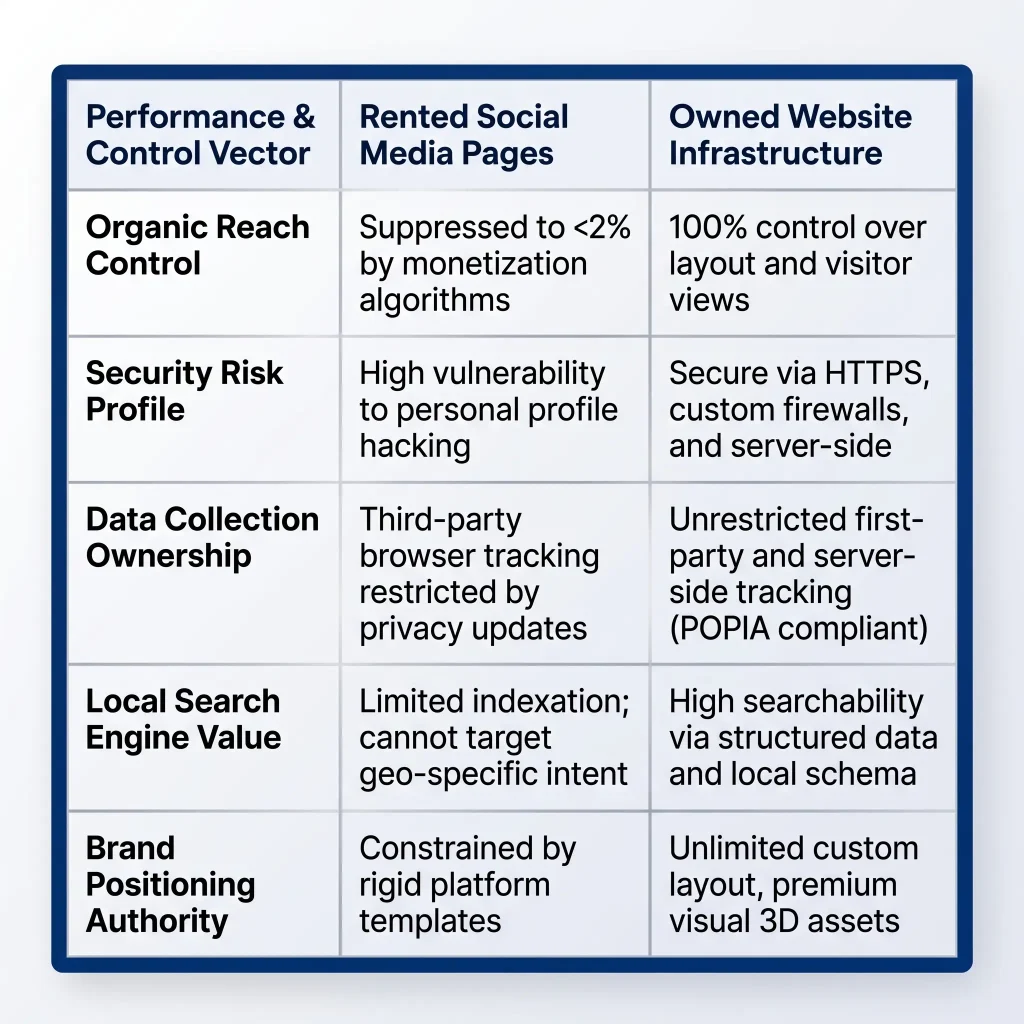
According to PwC’s Voice of the Consumer Survey, 83% of South African consumers use social channels to discover new brands—a rate far higher than the global average. At the same time, 82% actively seek out online reviews and verified digital assets to validate their choices.
This points to a clear digital strategy sequence: You should use social media platforms strictly as high-volume discovery engines to capture initial consumer attention, but immediately funnel that attention back to your own secure, high-converting website where you control the user journey and protect the customer relationship.
The Bottom-Line: Take Back Your Independence
We are not suggesting you abandon social media. It is an exceptional tool for building community and running targeted ad campaigns. But treating a Facebook or Instagram profile as your business’s primary digital asset is a critical operational risk, social media vs website for business.
When you build a custom-coded, high-performance website, you establish digital armor. You protect your brand from sudden algorithm changes, shield your operations from security exploits, build long-term local SEO authority, and position your brand as the premium market choice.
At Inspired Social, we don’t build generic web brochures. We engineer custom web architectures and secure data environments designed to act as your brand’s central command center. We strip away platform bloat to guarantee lightning-fast load times, integrate secure server-side tracking, and ensure your business owns its digital destiny.